

Stroop Buddy: Stroop test app
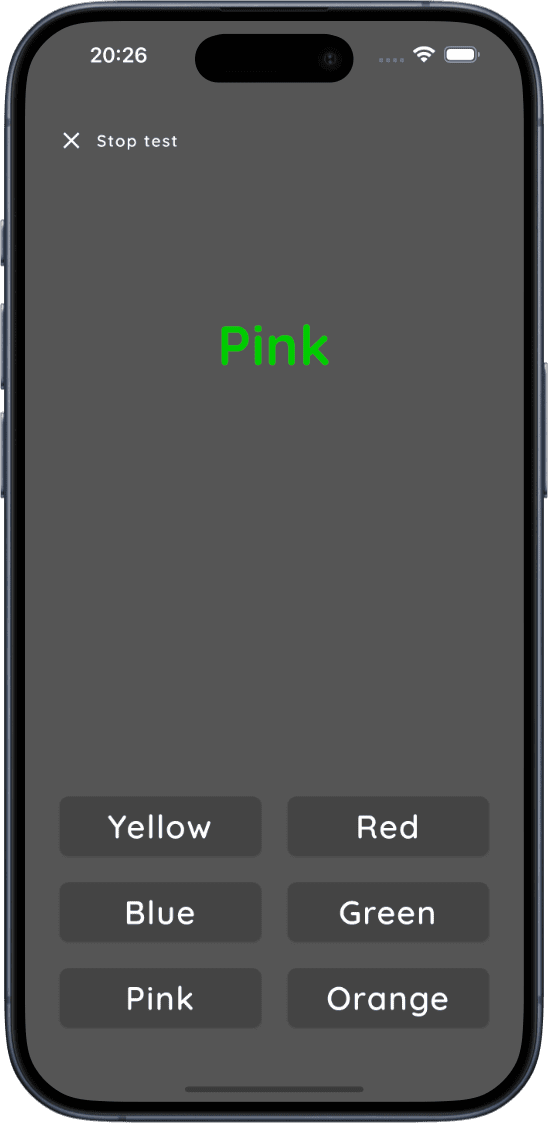
Stroop Buddy runs the classic Stroop color-word test on iPhone, iPad and Android. Participants tap the ink color of a color word, and the app logs every answer and response time for your analysis of the Stroop effect.
One-time purchase · No subscription · No account · iOS & Android · 9 languages
What the Stroop test measures
In the Stroop test, participants name the ink color of a word instead of reading the word itself. When the word and the ink color differ, for example "red" printed in blue, responses are slower and less accurate. This Stroop effect is used to study selective attention, cognitive flexibility, interference control and processing speed.
Settings
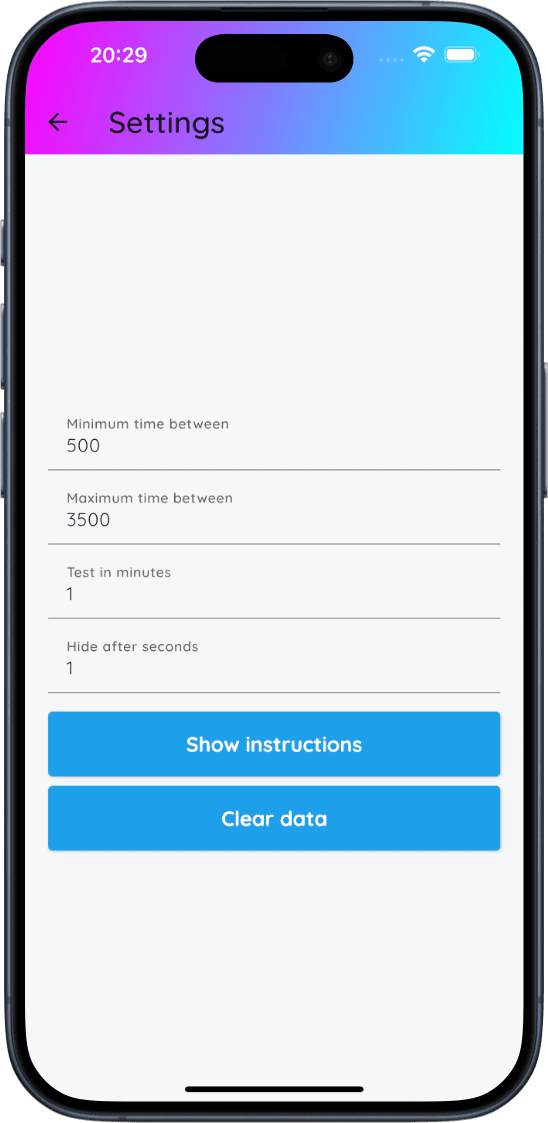
- Test duration: in minutes (default 5). Trials continue until the time is up.
- Minimum and maximum time between stimuli: in milliseconds (default 500 and 3500). Each interval is drawn at random within this range.
- Result display time: how long feedback stays on screen after each answer (default 1 s; 0 keeps it visible).
Each trial shows one of six color words (red, green, blue, yellow, orange, pink) in one of the same six ink colors. Word and ink color are drawn independently, so about one in six trials is congruent. The six answer buttons are shuffled once per session. A trial without an answer ends after 5 seconds.
Results and CSV export
After each test you can add a test name, remark, sex and age. The CSV has one row per trial with the columns Color text,Color value,Answer,Correct,Answer time,Time taken in milliseconds, followed by the test duration, the average, fastest and slowest response time, and the number of responses.
Because each row holds both the word and the ink color, you can split trials into congruent and incongruent and calculate the Stroop interference effect and accuracy per condition in Excel, SPSS, R or Python. Color values are always written in English, whatever language the participant used.
Data and privacy
Stroop Buddy has no account, no server and no analytics. Test results are stored only on the device and leave it only when you export a CSV. On Android, the system's own device backup may include app data. See the privacy policy for details.
Timing
Response times are recorded with millisecond resolution using the device clock. As with any touchscreen task, the screen and touch sensor add a small delay that differs between devices, so use the same device for comparisons within a study. Stroop Buddy runs on iOS 15 or later (iPhone and iPad) and Android 7.0 or later.
For research and education. Research Buddies apps are not medical devices and are not intended for diagnosis or treatment.
Stroop Buddy FAQ
Is Stroop Buddy suitable for my thesis?
Yes. Stroop Buddy is built for measuring response times and the Stroop effect in a simple, controlled way, which suits bachelor and master theses.
Do participants need a lot of training?
No. The task is straightforward. You can briefly explain that participants should respond to the ink color, not the written word, and then start the test.
Can I change the test length and timing?
Yes. You can set the test duration and the minimum and maximum time between stimuli so that the Stroop Test matches your course assignment or research design.
Can participants take the test in their own language?
Yes. The color words and answer buttons follow the device language: English, Spanish, Portuguese, German, French, Dutch, Japanese, Chinese (Simplified) or Arabic. That matters for the Stroop test, because the effect depends on reading fluently.
How do I cite Stroop Buddy?
Cite it as software, for example in APA 7 style: Byrt. (Year). Stroop Buddy (Version x.y) [Mobile app]. https://researchbuddies.com/stroop-buddy. Fill in the version you used and the year it was released. Both are shown on the app's App Store or Google Play page.
Reference
- Stroop, J. R. (1935). Studies of interference in serial verbal reactions. Journal of Experimental Psychology, 18(6), 643–662.
Use Stroop Buddy with other Research Buddies apps
Combine Stroop Buddy with Vigilance Buddy for Psychomotor Vigilance Task (PVT) tests, NBack Buddy for N-back working memory tasks, Trail Buddy for Trail Making Tests, Go/No-Go Buddy for response inhibition, and Flanker Buddy for selective attention (Eriksen Flanker) tests, or visit the Research Buddies home page to explore all apps.